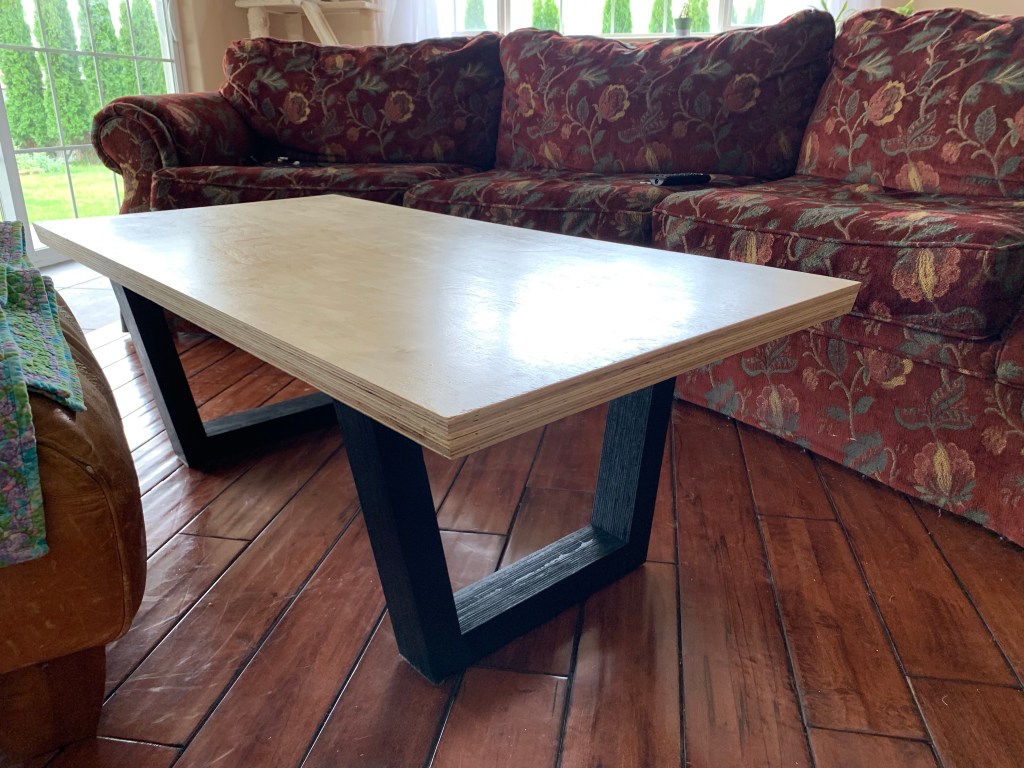
One sheet of very inexpensive, workshop-grade plywood is now a prototype of a 23″ x 47″ coffee table.
Pay no attention to that couch. It’s hideous, yes. It’s very temporary.
So, now it’s clear why I had a bit of India ink. I’d heard last summer that it seemed to be gaining popularity in use so had to give it a go. If you’re looking for a pure-black stain, this is a good choice.
I think on the next, presentation-version of the coffee-table, I’ll use finished Baltic Birch plywood as it has fewer voids and more robust surfaces. Maybe red-oak for the legs, still stained black of course.
Gosh, I can’t imagine why it may not have been working when I simply unscrewed the incandescent bulb to put in an LED.
Now that’s some ancient tech! Varnished cloth insulators were phased out back in the 1960s a few years after this house was built.
Looking more closely at it in some proper light, I’m rather astonished that it was even capable of sustaining voltage sufficient for the 60w incandescent bulb that was in it.
Yeah, I know, it’s a rental. Don’t care. Going to fix it. It’s part of my pay-it-forward policy of leaving a place in a better condition than when I arrive — in this case, I’ll replace every bulb with far more efficient LEDs.
How many?
Well…
Upstairs
26 incandescent bulbs around 60w.
A few first-gen CFLs. Heh, remember those things? When they were cold?! Outside?!?
Basement
Nine ancient ballast-driven, 4-bulb, fluorescent fixtures (yep, 36 bulbs). A few of the fixtures have failing and failed ballasts.
Another eight BR30 (60- to 120-watts) flood lights.
Outside
Oh, we’re not done yet — nine incandescent BR30 and BR40 flood lights between 60 and 120-watts.
The bulb that was in that fixture itself.
And a few of those flood fixtures are broken (unusable).
Total wattage? Honestly I don’t know. Didn’t keep track of exactly what wattage each bulb was. But with more than a few lights on, I don’t even want to think about what the previous tenants’ electric bills would’ve been.
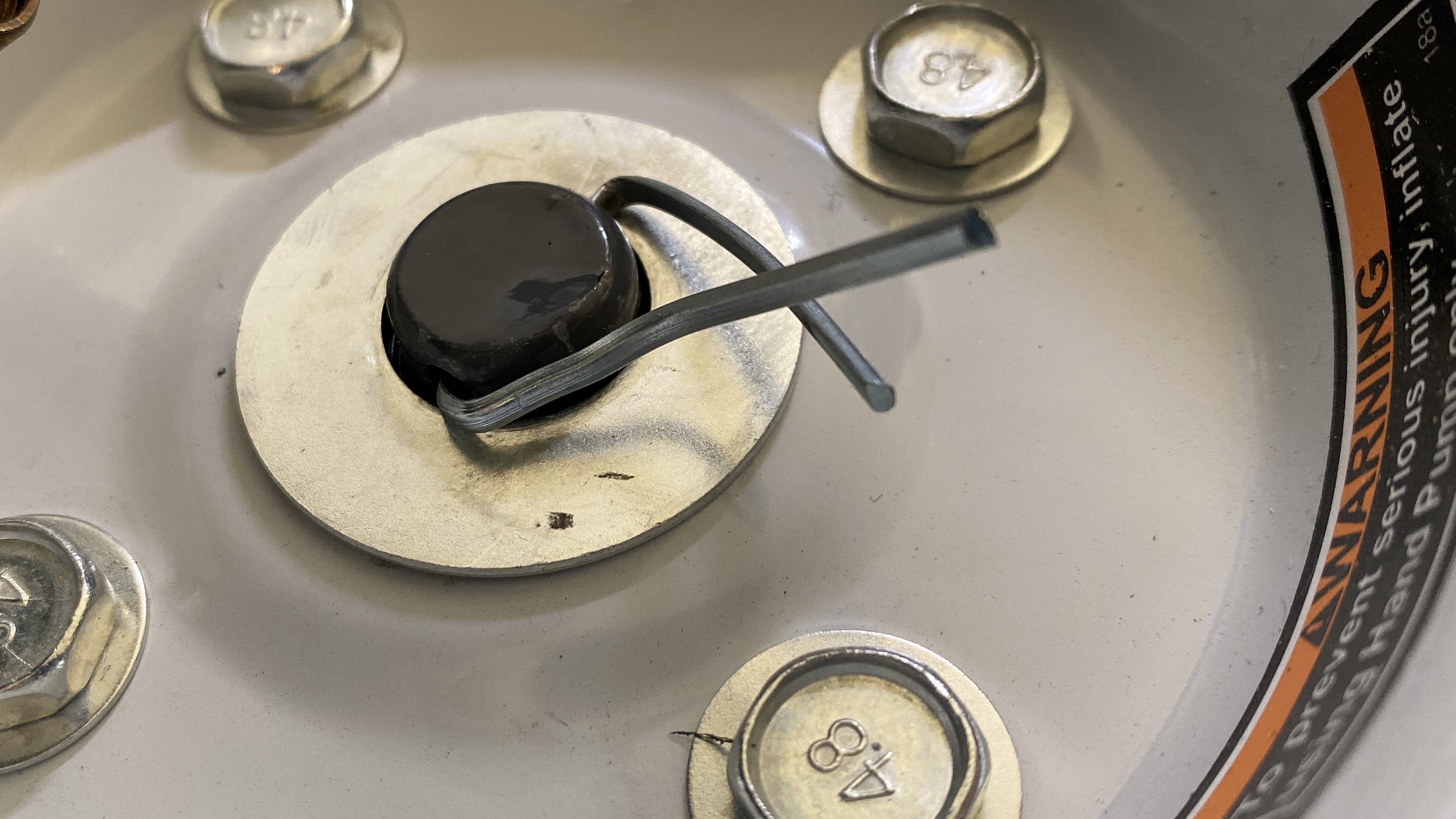
Had to pick up a super-inexpensive hand-truck to move. Then I discovered shortly after using it for a few minutes, the axle pin on one side was gone and on the other side, well…
Here’s what we like to refer to, affectionately, as, “The wrong way”.
As assembled by the shopkeeper.
I imagine the clerk’s thoughts were something along the lines of, “Why would this pin have a kink right in the middle of it?! I’ll just straighten it out…”




 the rest of me