COVID-19 Closures

A friend had remarked on FB, something to the effect of, “how are schools able to support online classes after two-days’ work, but had to close schools for snow?” Or something of that nature. He’s removed the post, while I was cobbling together a response, that goes something like this:

Maybe because this whole “online learning” thing is too new. We’ve only [he was a past co-worker with Pearson] been doing it for a short while now (nearly 20 years, now I think about it).

Things move painfully slow in Brick & Mortar education and business because, no doubt, there isn’t enough interest, or demand, or understanding to do so meaningfully.

It’s an unknown concept to many, and the unknown is scary to many people.

I expect that there will be a huge number of people that struggle briefly to deal with the tech-demands for live, real-time video & audio. There will be some that show up in their underwear and forget to turn off the camera. There will be some that forget how to mute their audio, or are oblivious to their own siblings or children — or their own chirping Smoke Detectors.

Also, if we think about the previous weather-related situations, school closures were only one or two days, maybe. Now, this new crisis is looking like it’ll be a few weeks to even few months.

They’re scrambling to react. That’s a good thing.

Also, we’ve an opportunity to do as much as we can to help, support, and educate the educators. After all, for telecommuters, this is all rather old hat to us.

Yeah, I do get a bit wordy on Book of Face every now and again.
The End of the Chapter?

…on our last episode.


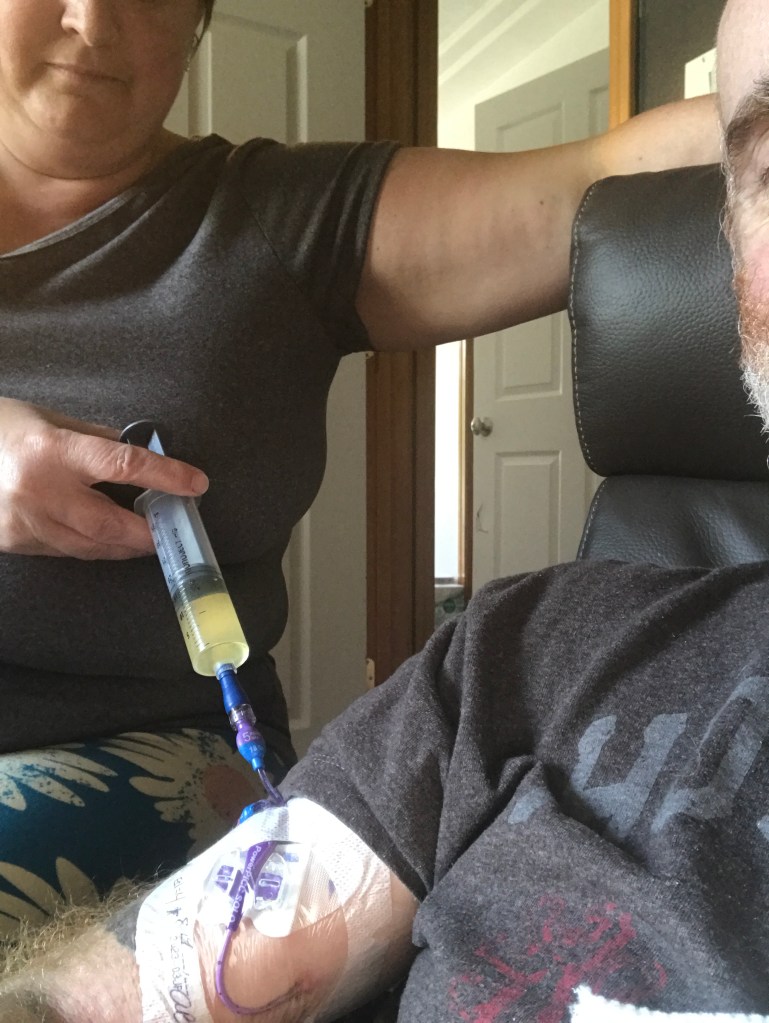
I mentioned antibiotics… I underwent an extraordinarily intense, many weeks-long IV antibiotic regimen to address what was determined to be a Streptococcus anginosus infection.

What’s curious, I think, is that Strep-a is typically an ENT infection — it’s that “strep throat” thing. Same species of bacteria. And, yet, there it was having taken up residence in my liver. One might wonder, how in the world such a thing could get there. There aren’t many plausible vectors. But, there it was.

Nearing the end of the primary antibiotics — about two weeks worth — it dawned on me that I didn’t have migraines anymore.

The migraines had ceased.

The assorted and worsening symptoms of the prodrome with which I had endured for so many years. The classic “migraine” headache.

Gone.

Completely.

Now, about 18 months later, I haven’t had any recurrence of a migraine. I had also not been aware of until it was gone, that I had some abdominal discomfort — that I thought was just normal — for decades. Since as far back as 1988 or so.

Did the aggressive antibiotics put a stop to them? Scientifically, I’d say they didn’t. But looking back at all of the small, overlooked, issues that’d I’d become accustomed and desensitized to, I’m rather confident that there’s a solid link between them.

My experience is little more than a single data point — and a single data point does not a trend make.

But it’s interesting and something of a curiosity, to me, that the life-long recurrence of migraines completely ceased after the intense IV antibiotic put quite an abrupt halt to the unperceived Streptococcus anginosus infection.

Obviously, we can’t subject everyone with migraines to full-body CT scans in pursuit of zebras, treat the symptoms. But I think it would be interesting to investigate and observe the WBC trend is in those otherwise healthy patients who suffer from frequent migraines. But it wouldn’t be unreasonable to consider that an infection may be contributing.

* A few days before posting this, I had shared this backstory tale with my physiologist. We both reviewed the abdominal CT scans from August 2018 and the scans captured on the date of the fall (December 2017). We’re in agreement that it’s simply inconclusive. The scans do not provide any visible indication of infection within any organs, liver or otherwise. Yes, the scans from 2018 absolutely make clear that there was a significant abscess. But from 2017, there wasn’t enough information to indicate “Yes, there is.” Nor “No, there isn’t”.

Further study is needed.

…🕸📜


Next time on Migraines | All

A Boss Battle?

…on our last episode.


We then immediately turned and made the hour-long drive to Wenatchee, which would become my home of sorts for the next week while they worked to save me.

Again.

While Samaritan was registered as a Level III trauma center, Confluence in Wenatchee wasn’t even listed as a “trauma center”. It is, however, a much larger and far better-equipped facility.

There was a brief intake to its ER, a quick consultation with one of the residents, and I think they noted that my mental state was beginning a rapid decline.

They then immediately rolled me over to one of the CT rooms and began a CT-guided percutaneous aspiration and drainage.

More radiation from the CT. More IVs, admission as an inpatient, and my decline was halted, but it was still substantial. I’m told in retrospect that they were rather concerned because of what it was, where it was, how substantially my mental state had degraded.

But we absolutely had an explanation for the fever, and all of the ancillary medical issues that a significant liver abscess would include. Weakness, collapsed lung (yep, really significant infection distended my liver… so… a lung couldn’t do its lung thing, apparently).

And if I wasn’t already struggling with recovery from the severe TBI — sound, speech, balance, fatigue — I would be now.

A week, a few more CT scans — I think I’ve had my radiation dose for the next 12 years, thanks — I was well enough to discharge. I’d also have some significant antibiotics for the next month or so.

…🤒📜


Next Time on Migraines | All