Well, after some careful examination, it’s become abundantly clear that the previous owner had indeed rewired the heat control circuitry in the furnace.
Could I set it right? I could, sure. Do I have all of the needed elements/parts to? No, I’d have to source, order, await delivery, etc.
How long would it take? A few months.
I simply haven’t the time we’d need.
I suppose that means rebuilding is out of the question. Which leaves us with obtaining a replacement. So, I’ll be shopping around as our limited time permits to source a replacement and we’ll install it.
I feel somewhat discouraged by the fact it’ll be new, installed, then removed or disposed in a year or two.
I wonder if I could make do over the winter with a reasonable supply of firewood for the wood stove and kerosene for the portable kerosene heaters.
The wood-burning stove is, itself, fine, but its installation appears to have been cobbled together by a drunken installer then bashed into the house — no doubt without those annoying or inconvenient permits or building codes. We have it sorted, for now.
But, next on the task list is getting the 50 year old electric furnace sorted out. We’re entering fall and overnight outdoor temps are dropping to about -5℃. When we enter the depths of winter, we’ll see daytime temps as low as -25℃. Sure, a fireplace is “cozy”, but we won’t want to rely solely on the fireplace all winter.
I’d like to get the ancient electric furnace working. I don’t want the indoors to be a tropical 28℃ in the winter. But I’d be happy if we could have a safety-limit of 15℃.
A couple of things can be readily determined — well, apart from its extraordinarily-obvious “It doesn’t work” condition.
It hasn’t a thermostat. Not a big deal, one can just jumper the two wires on a simplistic furnace. And, while this particular, er, domicile absolutely cannot justify a smart-thermostat, just any thermostat will work. I think I’ve still the old Honeywell thermostat that I’d replaced in the Moses Lake house with a Nest. That’ll solve the thermostat problem.
Are its breakers tripped? Nope — they’re fine. At the service panel and the on-appliance breakers.
There’s not a chance in hell that anything in here would be quick to repair. Dig in and make a list of every potential at plausible fault points:
Visual appearance of the exterior:
The low-voltage thermostat wiring (24VAC) needs a jumper wire between two terminals. On an older style HVAC, wires for the thermostat were typically connected to terminals L and 2. Terminal 2 would then be shunted to terminal C.
Shown here: quickly extended term 2 to C
Just looking at it, one could see that the jumper wire was simply folded back out of the way. Why in the world would they have disconnected that? Were they gnawing on the wires to strip off a few inches of insulation then attaching them and hoping for the best? Eh, easy enough to correct. But that’s not all, with certainty.
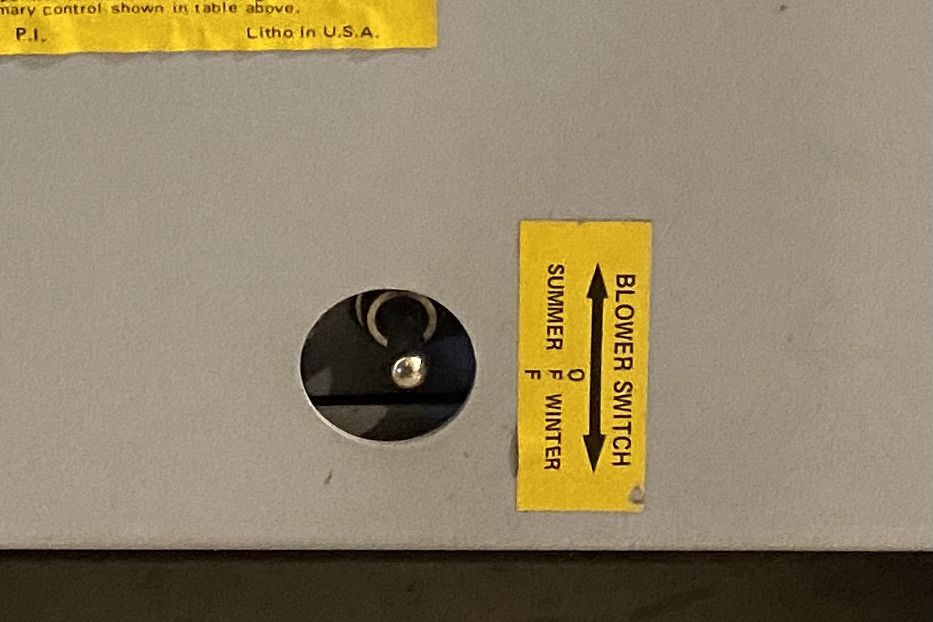
Is it in “winter” mode? Yep. That’s a switch to turn off, or switch between enabling heat or blower only.
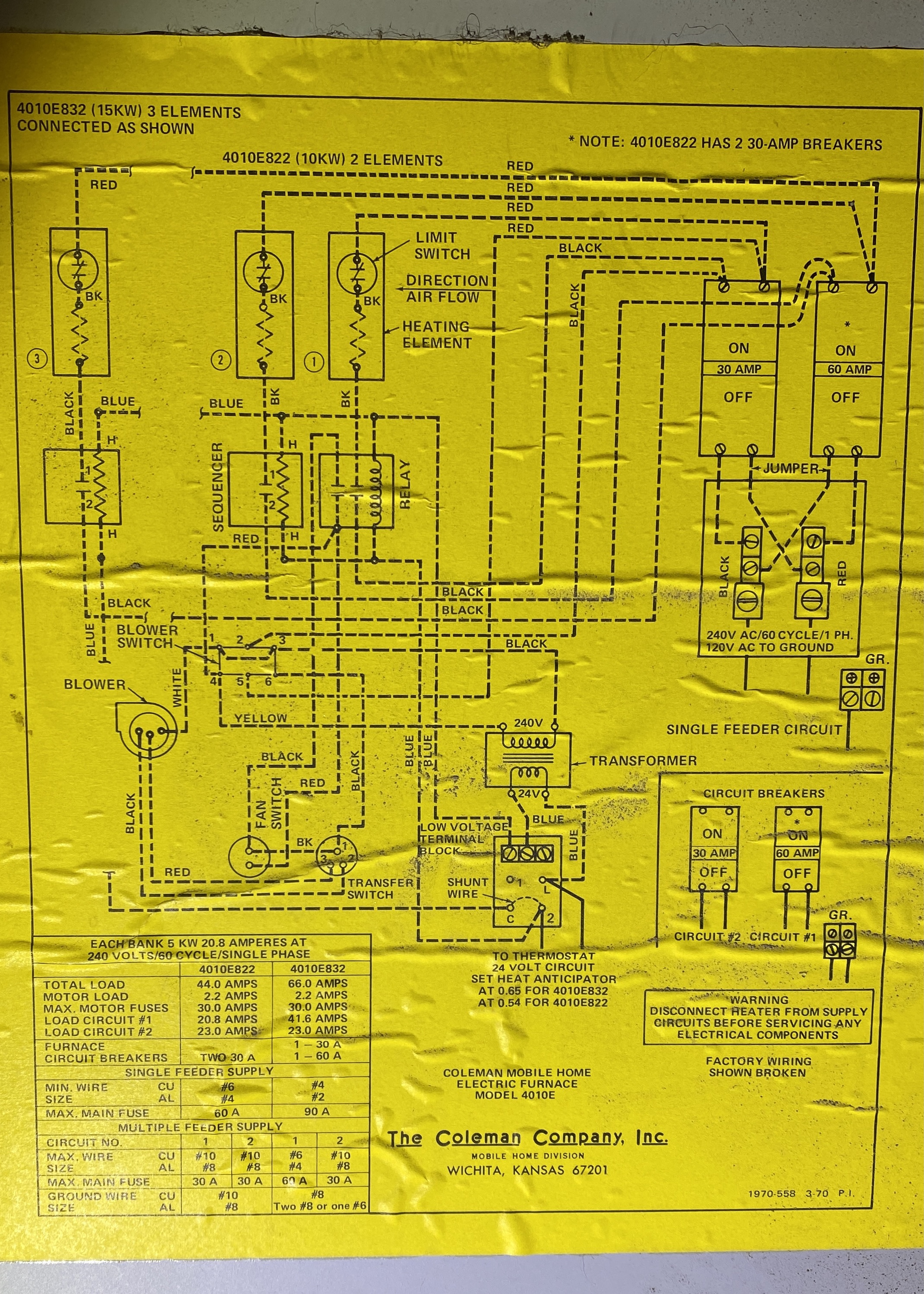
Knowing that previous occupant fancied himself an electrician, I’ll have to look at the innards of wiring… he no doubt “fixed” it thinking he was going to make it work or work better (or work more better?). Ah, yep… he fixed it so well that the power wires for the blower itself have been cut…
…then spliced together… others disconnected and ends removed entirely.
Quite fortuitously, manufacturers back in the day, Coleman in this case, included a complete wiring diagram inside the service panel.
That’s a win right there.
There’s but one of me to do the work, and I’ve a limited amount of time available during the week to work on prioritized corrections to make this, uh, habitation livable. Sure, there are other extremely important issues to be sorted as well, but during the time I have available, I need to address one problem at a time.



 the rest of me