Generators

Don’t be the person at the campground with the cheap, unmaintained, builder-grade generator. Just. Don’t.

“But it’s the best/biggest thing I could afford!”

You’ve approached it by trying to solve the wrong problem. The problem is not, “How much wattage can I get for $1,000?” It should instead be, “How much generator do I actually need balanced with how badly do I want to annoy the hell out of everyone around me?”

Save a few more dollars and buy the best-quality, inverter-style, eco-throttle, RV generator available to you. You and your neighbors will be extremely grateful.

And, yes, a 2KW generator really will run your RV’s air conditioner.

After having to listen to the neighbors on both sides run their 9kw Champion and 8kw Honeywell generators for the entirety of the non-quiet hours and well-into quiet hours, I find myself pondering the plausibility of a remote generator-disabling mechanism.

For my own, future reference, I’ll leave these here:

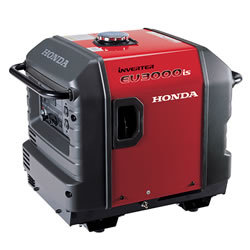
My #1 pick, if I can find a good spot to mount or install it is the Honda EU3000iS

image

I wonder if it could be fit into a 5th Wheel’s typical generator bay.

I hear (hah!) it’s the quietest generator in its class. There’s one here at the campground that I walked by and I’m quite impressed with it.

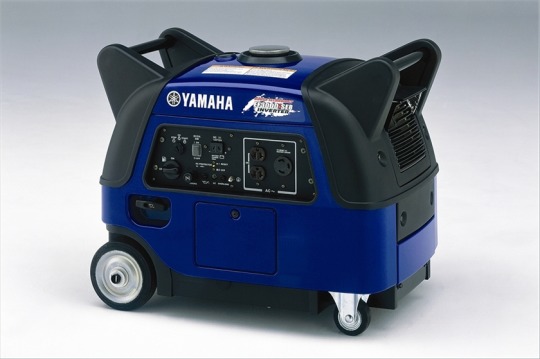
There’s also a nearby site with a Yamaha ES3000iSEB, which, too, is quite nice:
image

There are, of course, built-in options available from Onan – maybe the RV QG 5500 LP would be well-suited to the task.

I think the Honda is the way to go. Prices vary. In my experience, paying a bit more for better quality up front, and caring for machines and implements properly will greatly reduce their overall cost of ownership and improve their reliability and usability in the long run.

For now, I’m going to try to enjoy the 100F heat without resorting to running my own generator and contributing to the noise pollution.
Warning – Scary House Remodeling Photos Follow…

Oh, bathrooms. We need them. We don’t like to think about them. We don’t want to be without them. Even if we know that there’s something needing some repairs, we keep putting it off.

We knew when we bought the house that there were two old water leaks, which we’d corrected early on, and that we’d eventually need to address some already-weakened floor under the toilet and tub.

How bad was it?

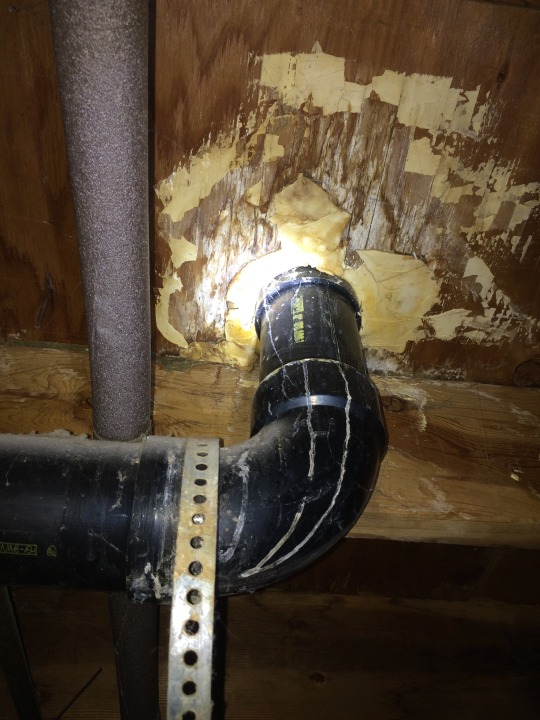
Here’s what it looked like when we moved in – with some evidence of someone having used wood filler in an attempt to shore up the problem around the 3″ closet flange:

image

Rather poor condition.

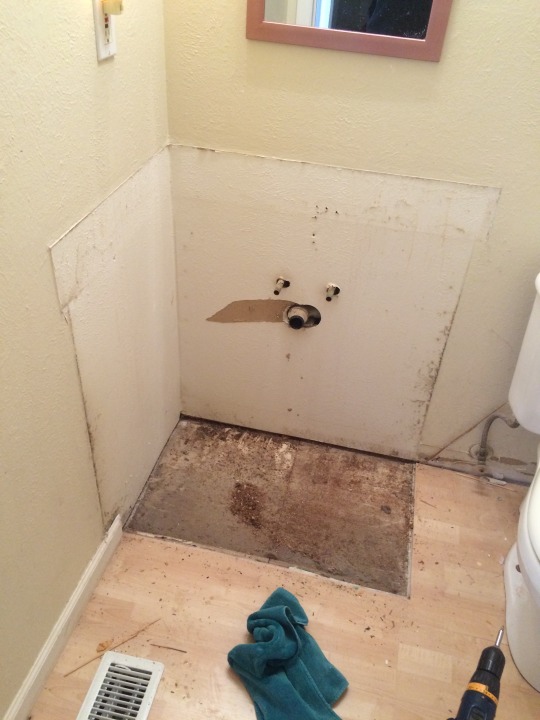
So, last Thursday, that flange finally failed. Time to pull the toilet out. But, as it goes, removing one problem reveals another. Then another.

Everything must go!

image

Yep, everything.

1973, builder-grade vanity? Gone.

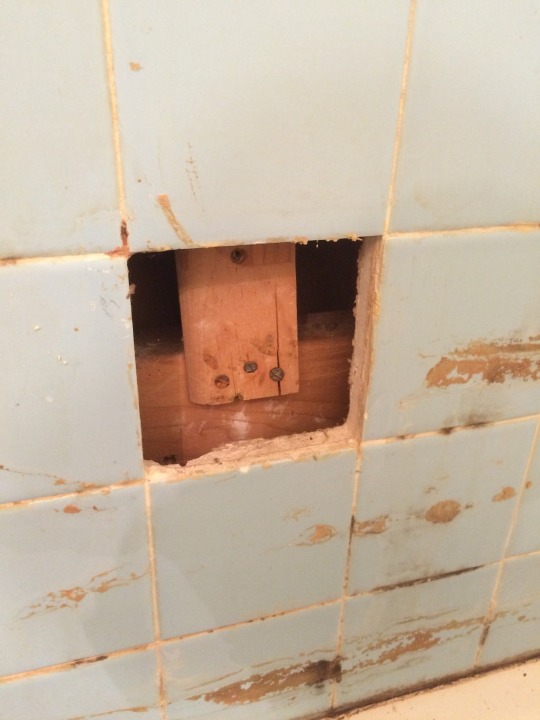
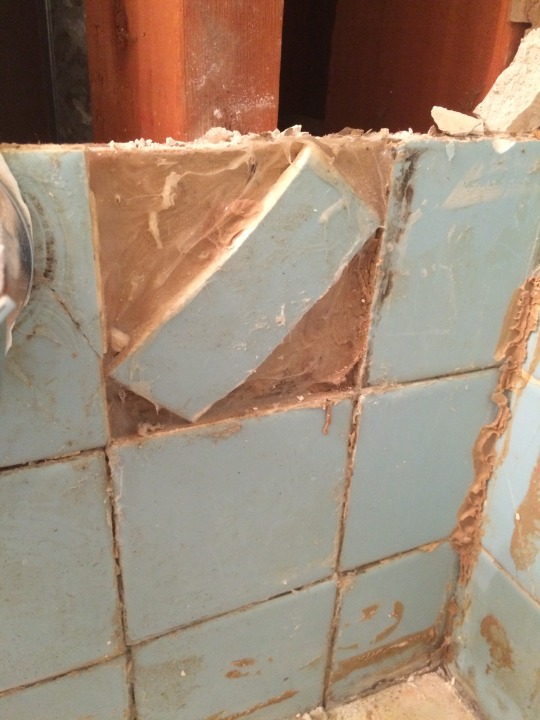
Some explanation of this one may be needed – see, the old shower surround was really a cheap plastic kit that a previous homeowner/tenant had glued to the tile. So, I pulled it off and found this:

image

No idea why a single tile was cut out.

Oh, it gets more strange.

image

Yep, that’s half a tile that has been turned and glued in to where a lost tile was. No idea why.

There was also an amazing amount of silicone caulk and adhesive around the shower valve and the wet end of the tub. I can only assume that they thought they had a leak somewhere, so they just sealed everything.

Keep digging until we get to good structure.

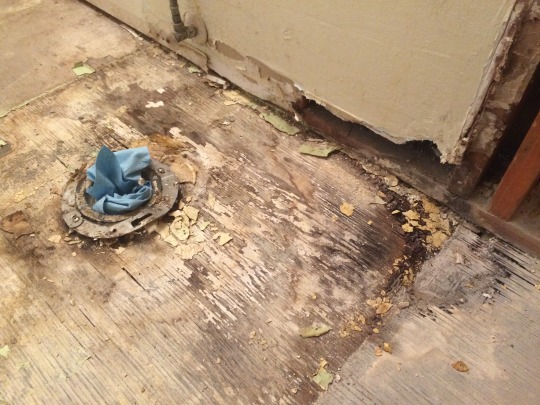
With the tub out, we can see the top of the subfloor, and how much damage it really has.

image

So, what’s the actual leak? On the right side, the water damage is from splash and spray from the shower, which weakened and rotted the floor and drywall. That weakened the floor around the closet flange, which itself is really inadequate by today’s standards, which then failed, too.

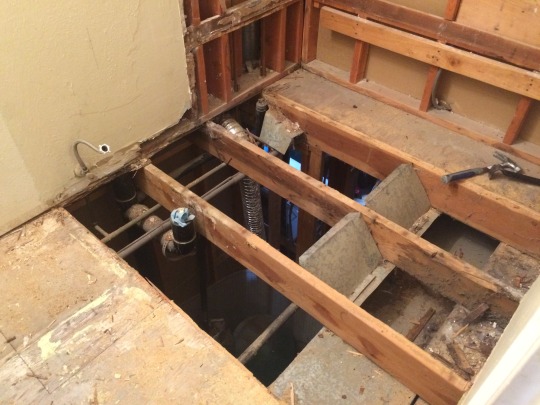
Everything must go!

image

The joists are actually in surprisingly good condition. Time to clean up all the tear-out mess and that cold-air return duct and move on to reconstruction.

image

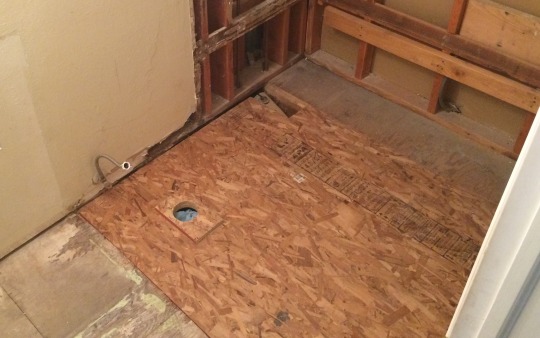
Some new OSB cut to fit, adhered with correct adhesive and fasteners to the joists. I also added a spacer to the correct height to support the closet flange on the finished floor.

Now, let’s install a tub:

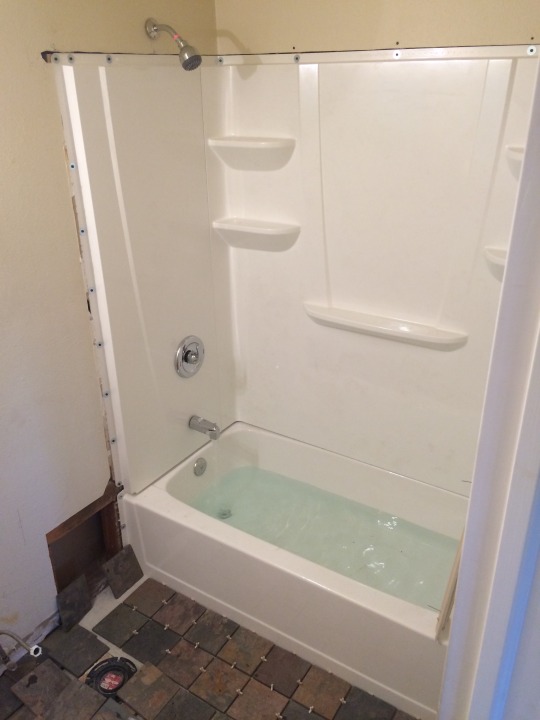
image

No leaks. That’s a good sign. Although I do need to make a new stem for the spigot, but 3/8″ shorter.

image

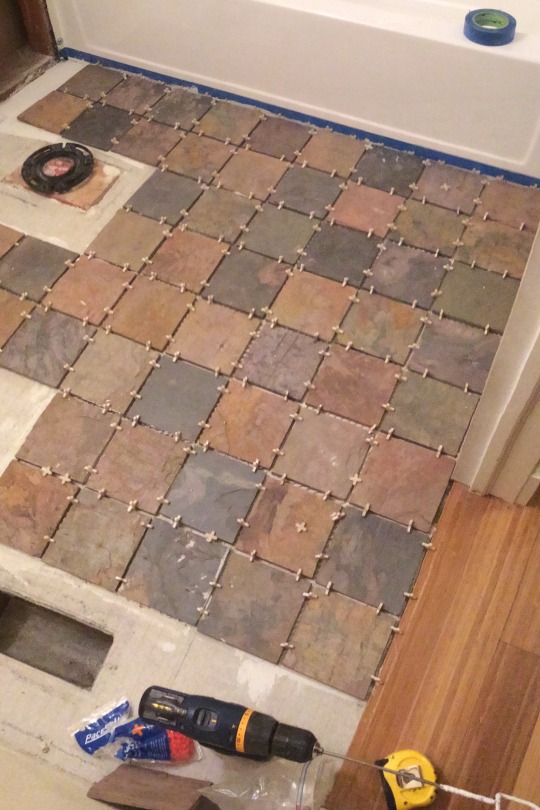
Yes, natural slate in a bathroom. I’ve had natural slate in the front entry for nine years and they’ve been completely maintenance free.

Unlike the slate that I bought and installed in the front entry many years ago, this batch tends to be mostly not-square and highly-varied in thickness. Frustrating. So, the spacers here are more what you might call guidelines than actual rules. Shift here. Shift there. Adjust for not-square walls, and… hopefully the end result will be worth it.

There’s the three days’ work so far. I’ll get the rest of the tile in this evening including all the cut pieces, then get it grouted tomorrow evening.

With luck and good timing, I’ll get the toilet installed by the following afternoon. That’s a good thing, too, because by then, we’ll need to take the trailer out to empty the tanks.

Observations From The Latest Trip

  • The dual-battery config on the trailer did really well for the long weekend of boondocking. In fact, we could’ve gone several more days on battery power, even running the furnace at night to keep our little hybrid trailer above 55F.
  • We would’ve run out of fresh water before we run out of power; but still had about 20 gal. on board when we departed (used 25 gal.).
  • No nearby dump stations, so if we were to actually plan on boondocking anywhere, we’d need a waste solution (like a Thetford SmartTote or something).
  • The next truck will be an actual 4×4 for the extra terrain-traversing capability it provides.
  • Allison transmissions on diesel trucks are awesome. Except when you’re doing a long descent… without an exhaust brake.
  • The red-line on the 2002 6.6L Duramax is 3,200 RPM. The Allison transmission will dutifully shift down to 3rd while doing 65MPH.
  • The sound of a diesel V8 pulling 3,500 RPM is a little unnerving.
  • Add ‘exhaust brake’ to the list of improvements we’ll need to make… along with:
  1. canopy
  2. lift pump
  3. exhaust brake
  4. new tires (and full-size spare)
  5. replace trailer spare
  6. compact, quiet generator option

Yeah, there will be a few dollar signs.