A distilled summary of the different terms that sounds similar in different English-speaking regions.
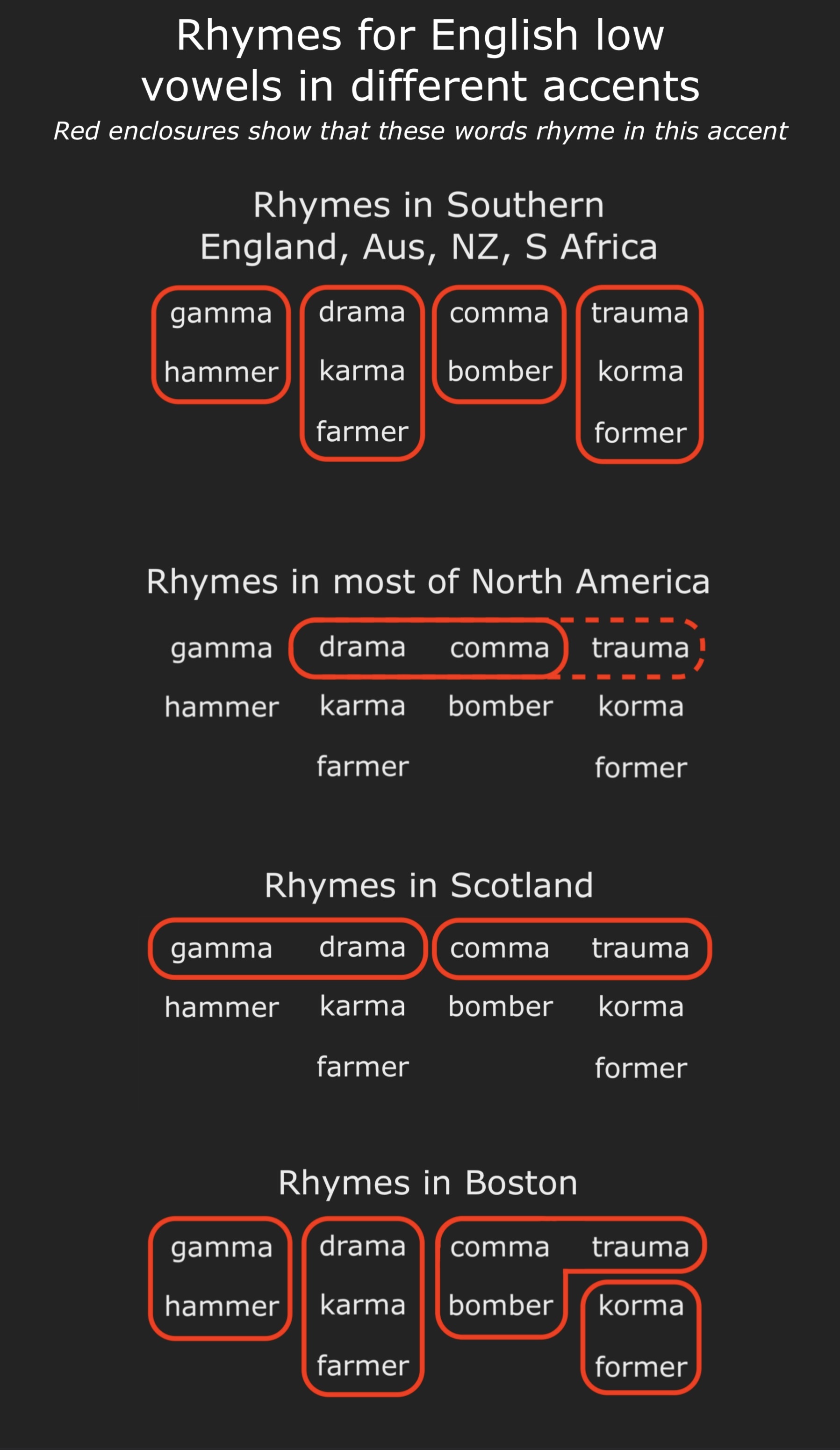
I suppose one of the takeaways one might take is that North American English is unique enough.

A distilled summary of the different terms that sounds similar in different English-speaking regions.
I suppose one of the takeaways one might take is that North American English is unique enough.
I could add a few… okay, several terms to this list.
A few months ago, I did a brief rant about a mechanic/fabrication test question that used angle in reference to a distance.
Diameters.
At issue was the size of an angle in reference and relation to a diameter — a diameter that would be on the order of a few fractions of an inch to a few inches. A bend radius of a wire or wire bundle.
It has now occurred to me that, yes, you most absolutely can use an angle to measure a radius.
We use the concept of angular diameter in calculating long-range distances of several hundred meters. Rather, in that regard, we use the (forced) perspective and a few simple trigonometric functions (sine, cosine, tangent) to measure a distance to a target.
We often use angular diameter in astronomy to determine the distance to a star or to a galaxy.
I will stand, therefore, partially corrected.
I still think it’s abnormal to refer to the angle of a radius.
Haven’t seen this movie in about forty-two years. And I never noticed this back then, but, I gotta ask: what the heck is a “Srand Prix”?

“No! It says ‘Grand Prix’! Duh!”
It’s presented in Fraktur script, which was incredibly common in Germany until it was verboten by the Nazi party in 1941.
Anyway, that first letter that you may readily and quite erroneously interpret as a G is really an S.
In printed (not hand-script) Fraktur, for reference, here are the letters E-F-G-H-I:

And Q-R-S-T-U:

Context matters, of course. Yes, it’s just a movie. Yes, it’s just a musical. And, yes, it’s just entertainment.
Honestly, people readily understood what was intended.
And that’s what matters.
A Homophone is, of course, a word that has an identical pronunciation to another word but differs in meaning.
Certainly not an English-only concept, Homophones can be found across many (most?) other languages. In German, I know of many (more perhaps), and can even think of several in Spanish.
In English, the pronunciation can vary slightly depending upon region and dialect. I’ve marked the ones (with *) that, for me, tend to have a subtly different pronunciation:
 the rest of me