𝒇(𝓧) = The Generation of Functions

I honestly don’t really have a need for a function generator. This was inexpensive and small enough to fill an hour’s time.

fullsizeoutput_3f30

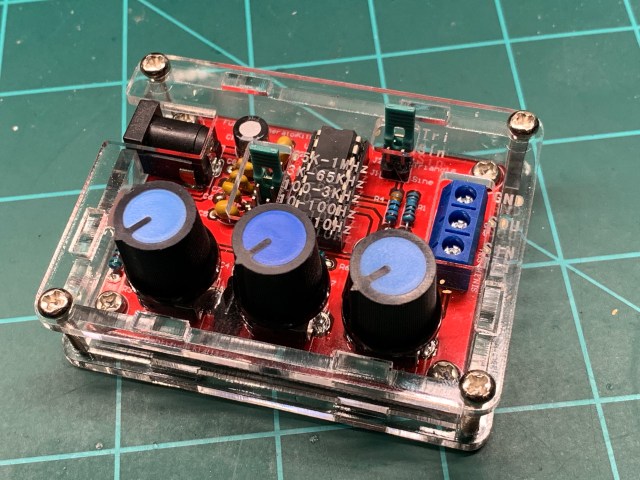
The most time-consuming part was understanding what orientation the electrolytic capacitors were to be installed. While the silkscreen on the PCB did have an indication that the capacitors had to go one way, there wasn’t a positive/negative marking. So I guessed that the white on one half of the circle must equal white on the capacitor.

fullsizeoutput_3f34

Oh, and peeling off the protective coating from the acrylic parts. There are a few bits still inside of some of the letters.
Xq5IxZNRTmeyq4pfvQ0eUg

There’s probably a slightly more elegant function generator — actually, there are several and more expensive — but this will do for now.

Before I build too many more things, I should see about building a power supply. Maybe the ubiquitous LM317 would be a reasonably inexpensive and capable project.

Also, it seems to me that I’m continuing to do things backward.

How so?

Because one would think that learning tasks would start with simplistic concepts and work toward more complex. I started with the complex (the QCX project) and moved over/back/into this, the simple.
Touch to send…

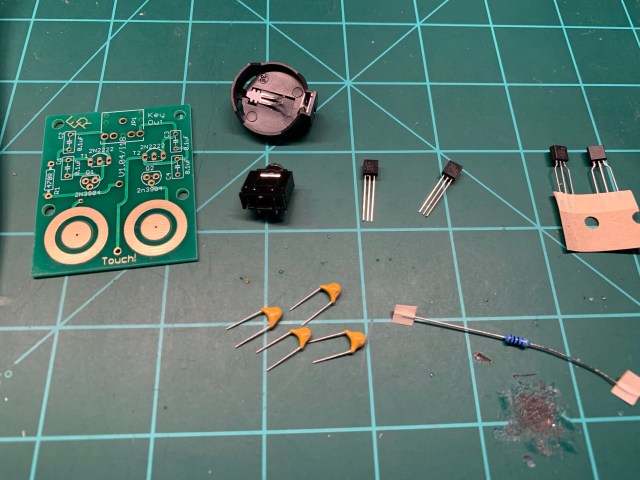
An assortment of parts that is almost, but not quite, entirely unlike a key.

bnRv0VqMSn2o02EV0eJWXQBefore.

Not nearly as complex as the two transceivers and oscilloscope that I’ve recently assembled.

GGQC93bESbC5NkRO4iLeYgAfter.

I suppose with the dexterity issue I currently have, it replicates closely enough an iambic paddle. I’d like a real paddle — but I have absolutely no interest in dropping the going rate for one.

I should also see about locating some hundred-plus year old tech and some robust wire to hook up keys. Hmm… or maybe there’s even a simplistic wireless tool that I can use to bridge the gap between devices. Yep, there’s something of a conflict in pondering the use of modern Bluetooth technology to interconnect tools, to then send nearly 200-year old signal (Morse Code) over a 125-year old (Radio) medium.

I am a bit of an anachronism.

Complete…enough.

Nothing is ever truly complete. But, this is complete enough for now:

DSC00163

Had to power it on and work through an alignment procedure and make sure it works.

DSC00164

This does explain that 50Ω dummy load a bit as well.

It’s complete enough: It works, so I’d call that successful. If I get really obsessive (I’m not), I could rework a few components and install it in a suitable enclosure and fabricate a suitable battery to keep it portable enough for lightweight QRP work. Maybe I’ll attach the already-mentioned GPS receiver and convert it into a WSPR node when I’m not using it.

Maybe I’ll build another for a 40 or 80-meter band.

All of that, of course, will need to wait. I’ve a few simple projects that I’ll be taking on, and, quite importantly, improving my morse-code comprehension and speed.

For now, I’d like to thank QRP Labs and designers of the kit that was originally intended for Britain’s RSGB Youths On the Air Summer Camp of 2017. This was great fun and was hugely beneficial for me, not only for learning, but also to improve some manual dexterity and mental focus during this extended TBI recovery.

Well, That’s Not as Annoying

After a bit of research, I realized I was most certainly using the wrong revision of instructions. Whoops.

I have a Rev 4 kit, but the instructions I’ve been using are Rev 3.

Well, that also explains why I have

  • four 10uF capacitors instead of six
  • a few extra 1uF ceramic capacitors and
  • why I have two extra resistors laying about

The good news is that I won’t have to remove or rework anything, yet I won’t know for sure until I’m done assembling and testing.

Note to self: make sure the schematics match the PCB… and vice versa.

The story so far:

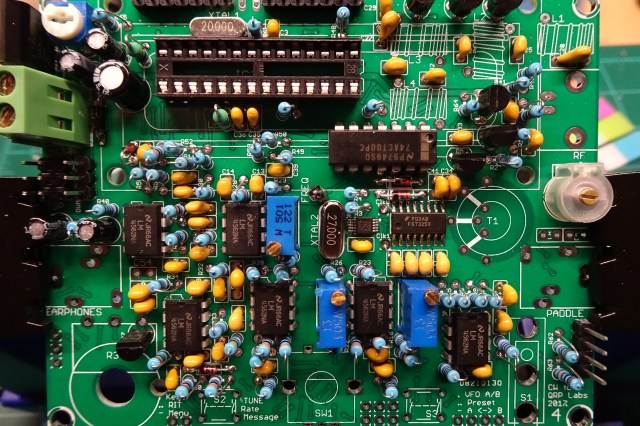
DSC00161

Still several more things to do yet:

  • toroids to wind,
  • a few potentiometers to install,
  • jacks for headphones and an external key,
  • a few pushbuttons,
  • and of course a display

Will it work? No idea. But I’m eager to find out.

Well, That’s Annoying…

Well, that’s a bit annoying… I was many hours into the build and noticed that the instructions were calling out a couple of electrolytic capacitors…

Image 3-1-19 at 21.43

Okay, but in reality, the silkscreen on the PCB differed…

DSC00159Not quite sure what the markings are for C21, C22, and C54. The silkscreen indicates a ceramic capacitor, but the instructions call for electrolytic.

Time to do some research as time permits…