A slightly more subtantial, and tunable QRP transciever, the QRP Lab QCX kit, is rather well-underway:

And I’ve come to the conclusion that I should really improve my interior project bench.
All in due time, of course.

A slightly more subtantial, and tunable QRP transciever, the QRP Lab QCX kit, is rather well-underway:
And I’ve come to the conclusion that I should really improve my interior project bench.
All in due time, of course.
My soldering is improving.
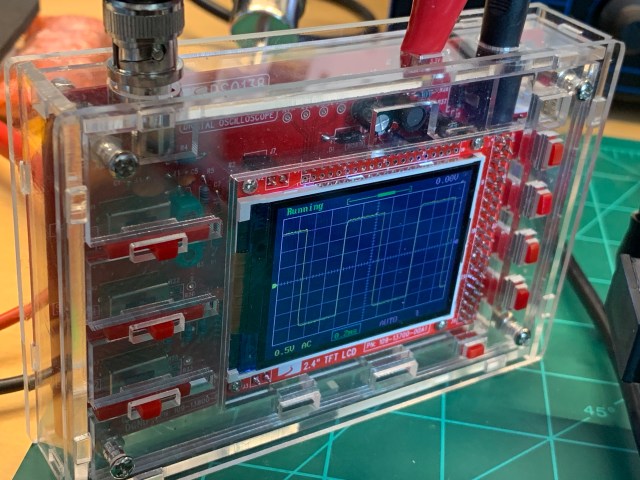
This is a DSO 138 Oscilloscope that I assembled from a provided combination of discrete parts. The purveyors only ensured two required SMD* chips were factory-attached.
At the US$22 entry price, including the housing, it was a fun and affordable project.
If you take one of these on as a project, be sure to do its calibration before assembling into the housing.
I’m sure there are also 3-wire or 4-wire probe combinations that I can add on in the future.
Next: Maybe I’ll start on a QRP-Labs QCX transceiver and see about obtaining a CW paddle… or maybe just turn it into a WSPR beacon.
*SMD chips are so small that they are often beyond the ready ability of most kit-builders because; they’ll require specialized special equipment to make them visible and differing soldering techniques.
The latest assembly from Casa de Juan;

A zap-o-matic? A high-precision random-number generator? A molecular stun-gun?
a 50-Ohm dummy load for testing transmitters up to 20w output to minimize the risk of
It’s effectively a sandwitch of small PCBs surrounding resistors along with an appropriate capcitor and diode to smooth out the signal while testing.
Yep, the soldering work still needs some improvement. Like the last project, I’m actually rather impressed that I was able to make it work as expected.
And next time, we’ll do something a bit more challenging.
The transceiver is fitted to the Altoids tin, and there’s sufficient space to include a battery as well.
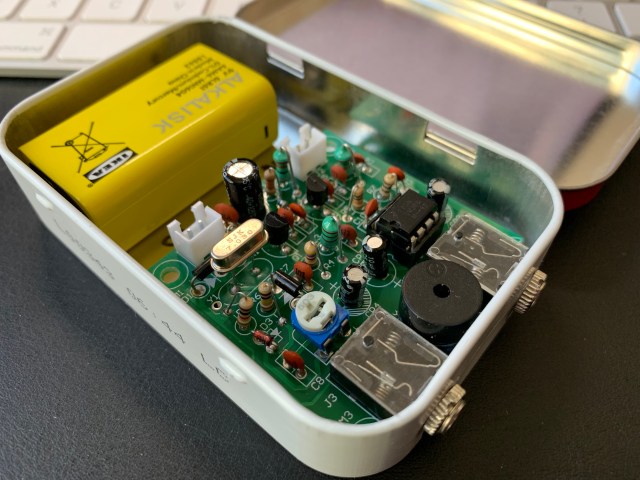
I’ll need to fit the removable jack for the antenna, and wiring harness for the battery, but I think it’s turned out rather well so far.
Apart from an astoundingly simple audio alarm and several car stereo installs, I’ve never built any actual electronic devices.
So I’m actually rather impressed that I managed to cobble together a Pixie_4.1 from parts and with only a schematic and some rather worthless Chinese-language only instructions:
 It even works, as well. I’m sure nobody was nearly as surprised as I was.

No idea how much power it puts out — maybe 250mw or so. Which, on the 40m band is quite sufficient to get out. Fun fact: No amount of power in the world will get out if there’s no path for the energy to travel. I once had a QSO from Denver, CO to South Africa (about 15,000 km) with only 250mw.
Anyway, back to the Pixie: I did switch out the originally-included 7.023MHz crystal for the 7.030MHz (upper left quadrant) to keep in my license band. I’m not ready to upgrade to Extra, so for now, I’ll stay in the General area of the bands.
There are a few things I’ll do as well:
These are incredibly inexpensive, and, for me, rather relaxing to go about sorting through parts, assembling, soldering, de-soldering, testing… perhaps I’ll see about even building another. Just because.
Next, I’m quite interested in having a go at assembling the QRP Labs QCX CW Transceiver kit (greater complexity) and even a DSO138 Oscilliscope (SMD and smaller components) as well. Obviously, I’ll need to improve my CW skills, and I even have a J-37 key that K0AOG gave me many years ago… but I don’t have the needed manual dexterity or hearing (different story), but I’ll get to that.
 the rest of me