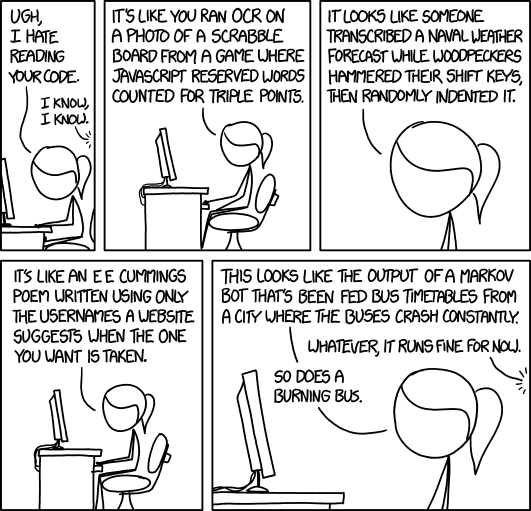
That’s how I code, baby. That’s how I code.

Any organization whose primary business goal is to be everything to everyone and who requires that you create a fully portable profile.
I’m looking at you, Microsoft… particularly when it comes to XBox profiles.
Hey, any parents out there thinking about converting your kid’s local XBox 360 profile into a full-fledged Microsoft Gamertag with the ability to actually, you know, download game updates, join online games, and such: not possible.
After finding out that you can’t create the account on the Xbox, but have to use a computer. Then after finding out that the standard troubleshooting is “clear cache and reboot”. Then seeing that it’s just Microsoft’s blatant hatred for Macs. Then… then I finally stumbled across this little gem while searching the MS sites for more help with converting local profiles to full-fledged gamer accounts: “Note This feature is currently unavailable for child accounts. We are currently working on a solution. Please check back.”
And, a bit more frustrating is that I saw some forum posts from waaay back in 2012 that described the problem (and frustration with it). 2012. Four years ago.
Still. Not. Fixed.
Oh, by the way, if you’re thinking that you’ll just instead try to create a brand new account for your kid on the XBox.com site through their official process, then figure you’ll just add it to your XBox. Doesn’t work that way, my friend. “That account already belongs to a different profile. Please select another.”
You know what? Just give your kid an iPad and an allowance in the App Store. At least it actually works as advertised and as expected.
Eventual consistency is eventually consistent eventually.
Working with Terraform to create/destroy a non-trivial deployment into AWS can be an exercise in patience. The primary reason isn’t necessarily the quirks of Terraform – and it has a few manageable ones – but instead, it’s those things that we have absolutely no actual control over like Amazon’s necessary Eventual Consistency.
Eventual consistency, of course, is necessary because AWS is a distributed infrastructure. It takes time for configurations to be passed around to the assorted systems involved and implemented.
It works a bit like this:
Requestor: “Hey, Amazon, could you create me a VPC?”
AWS: “Done. Your new VPC ID is vpc-1234567890”
Requestor: “Great, thanks – now in vpc-1234567890, create me a loadbalancer named ‘webservers’ and one called ‘databases’”
AWS: “Whoa, woah, woah, woah! You need a VPC to do that.”
Requestor: “To do what?”
AWS: “To create a loadbalancer. You need a VPC.”
Requestor: “Yes, vpc-1234567890 – on that one, which you just created, put those loadbalancers in there.”
AWS: “I have no record of a working VPC with that name.”
Requestor: “But you just created it! You said, ‘Done: Your new VPC ID is vpc-1234567890’!”
AWS: “I said I created it. I didn’t say it was ready for use.”
Requestor: gives up… just before vpc-1234567890 is ready for use.
Just because the result code said it was “complete”, it doesn’t mean “functioning”.
However, because of Eventual Consistency, Amazon could take, per their docs, up to five minutes to complete some tasks, as engineers, we need to be aware and compensate for it. In practice, I’ve observed it can be just a few seconds, or even much longer than five minutes for some tasks.
I know what you’re thinking. You’re thinking, “I’ll just add a 30-second wait here or there.”
It’s a trap!
Instead, get creative and design your functions so they do a few things:
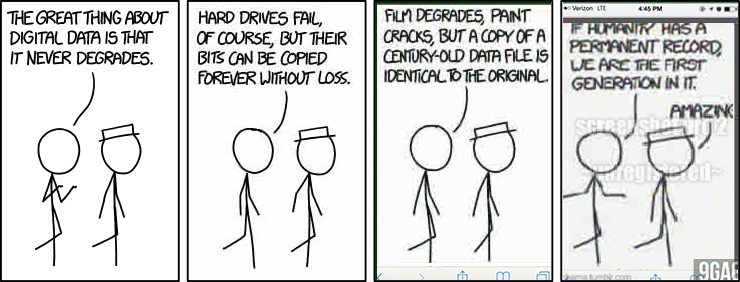
Digital Data–pretty much says it. I suppose a key problem is a lack of attribution.

 the rest of me