TBI Challenge n+1

Here I am, nearly eight years post-TBI. I’m still alive.

There are still two long-lived (heh) symptoms related to the TBI that I still struggle with regularly.

One of them is visual. Corrective lenses help to a point. And it’s exacerbated by simply aging — yay, presbyopia! I can cope with it to a degree.

But the other is just frustrating and leaves me feeling isolated from the world around me and yet bombarded by sounds. All sounds.

Let me explain.

After my TBI, I’ve come to describe my auditory system works more like a damaged signal-processing pipeline than a damaged microphone. The hardware (ears, cochleas, nerves) is intact, but the software stack that filters, routes, and prioritizes sound took a hit.

Normally the brain runs an automatic ‘noise gate’ of sorts that suppresses irrelevant audio, boosts meaningful signals (like speech), and manages bandwidth. Mine doesn’t always do that reliably. Under certain conditions—especially in noisy environments, multitasking, stress, or fast speech—the gating process struggles.

And when gating struggles:

  • Background noise and foreground speech come in at equal priority. I’m overwhelmed with “noise”.
  • I may hear a sound but not decode it. This one is difficult to put into words as human cognition is complex.
  • Some voices break through (especially familiar ones), yet others drop out.
  • Complex or rapid speech becomes garbled or unintelligible.
  • The whole system can overload and temporarily stop parsing input correctly.
  • It’s not hearing loss; it’s processing loss.

I do better with: slower speech, with one speaker at a time, quieter environments, visual cues, and a little extra processing time. Sometimes I’ll interrupt and ask, “Hold on a moment please while my brain processes this…”

Sometimes, it’s not possible nor realistic to ask for a moment to absorb or comprehend, yet I do my best to muddle through.

Once More Unto the Breach

Okay, perhaps a bit more dramatic than the comparison with combat and battle than was invoked in Shakespeare’s Henry V.

How about this:

Second verse//Same as the first

I missed out on two weeks of lab time way back at the end of Gen-A, six terms ago, when my wife had Covid. Way back before vaccines were available for it. I had to remain away from the campus to prevent spread and missed out on some critically important lab time because of it.

Fast-forward to now, and I finally have all of my lab time and projects complete and even have time caught up on the Airframe time that I needed to tend do.

So, great news, I’m all caught up.

But sometimes it’s two steps forward and one step back.

We’ve had four people out with a positive Covid tests in our rather small group of 14 — no idea about the 1st year students (about 30) or the other half of the 2nd year (about another 15). The three that were out are, to my understanding, planning on being back tomorrow.

But the administration has shut down our campus for a week.

So, we’ll be back next Thursday. We’ll have the shared frustration of all trying to get bare minimums on time needed to finish this last four weeks of the program.

No, wait… minus a week.

Last three… three weeks of the program.

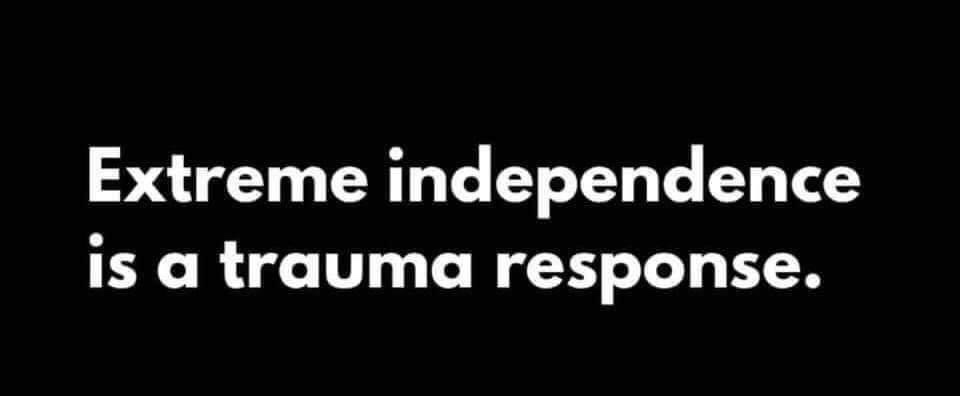
Extreme Independence

Yes, it is.

It can manifest in ways considered by many to be inconsequential.

For example, I will often insist that I can do some_task and steadfastly never ask another for help or assistance or guidance or opinion… to the point that it’s becomes self-destructive.

“Yeah…”, people will say, “that’s just the way he is. He’s just really independent that way…”

That extreme independence is the result of the combination of my own narrow-mindedness that I now attribute primarily to a lifetime of shaming and negative criticism that I’d received from a young age. After awhile, I simply accepted that I would either be tormented endlessly, or that I’d simply stop asking for help and set to figuring out a way to achieve whatever some_task I was interested in.

Tack on an unsettling degree of, what I’d find out many years later that we all cope with to some extent, Imposter Syndrome and… well… here we are.

Yes, Extreme Independence is most certainly a trauma response.