Tow Vehicles… Again…

We test-fit the kids’ carseats into a 2000-model Ford Supercab and there simply isn’t enough room to get the feet in.

That’s a No-Go.

Then we test drove the 2004 crew-cab. We really liked the amenities, but…

  • the oil pressure circuit is bad. Fixable, but could take some time to pin down exactly what’s failed. Could just be a minor electrical issue. $ to $$
  • the muffler had been removed — potentially problematic for our current Emissions-Required area. And, while I do like the sound of a turbocharged diesel with no muffler, the rest of the household would like to keep their hearing. That’ll cost $$
  • engine was missing periodically; two fuel injectors were failing. I can replace injectors, for a cost: $$
  • on the test drive, shifts were soft and sluggish and the engine power seemed to have taken its own early retirement. $$$

No-Go.

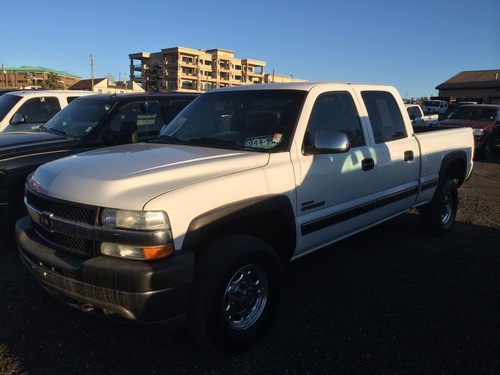
So, we browsed the lot a bit more and Daisy asked about a 2002 Chevy 2500HD crew cab.

Only 106K miles, but had evidence of a 5th wheel hitch in it. Guess I should be flexible on my “requirements“.

Let’s recap:

  1. Miles < 250,000: Yes
  2. Fifth wheel use: Yes, but…
  3. Towing axles: Suitable

In this case, the mileage and the surprisingly good overall condition, and that it has an Allison transmission means that its previous life as a 5er isn’t quite as significant.

A test drive showed almost everything worked reasonably well, but I didn’t get a chance to get it on a highway. Still, we did a little haggling over the price and… we’ll have a new-to-us truck in a day or two if she passes Colorado’s emissions test.
More on Trucks

Got a couple of leads on a few tow vehicles that will get the job done for us.

Currently, it’s a toss-up between a 2000 Ford V10 gasser, with only 70K miles and a known history pulling a 5ver of acceptable size.

…but it’s a supercab.

Or a 2004 Ford 6.0L diesel with a D1 axle, twice as many miles, and no evidence of fifth-wheel pulling.

…but it’s a bit more than I’d prefer spending.

Decisions, decisions.

On Trucks…

We attended the RV show in Denver yesterday. I’ll do a post on our takeaways later. Instead, I want to share here some thoughts about one of our important considerations for full-time RV living: the tow vehicle.

We don’t yet have a replacement for our geriatric Pathfinder. Obviously, before we can upgrade our trailer, we’ll need to upgrade our tow vehicle to something capable of towing the next trailer.

I’ve been looking around the last few weeks for a used ¾- to 1-ton class truck. There are essentially three things I’m watchful for on that search:

  1. Pass by anything with more than 250,000 miles on the odometer. Sure, diesel and some gas motors can run a million miles when properly cared for, but without knowing what the truck’s history is, higher miles are concerning. More than a quarter-million miles means, walk away.
  2. Check for evidence of a previously-installed FW hitch. There’s no way to be sure what they were towing with it, but I always assume that when there’s a footprint from a hitch in the bed, that the previous driver was pulling something heavy. Based on my observations of other vehicles and drivers over the years, I also assume it’s been too heavy. Previously-installed FW hitch means we should proceed with caution.
  3. An axle ratio not suited to towing: in the F250 and F350 arena, an axle ratio of 4.10 or higher is appropriate for heavy towing. But the 3.73 rear end is not. Run away from the 3.73’s axle code.

So, the next truck will need need the right drivetrain, limited evidence of abuse, and not too many miles. There are a few options out there that meet those criteria, but at our price range this will still be a bit of a gamble.

This is a long way of saying that we’ll also need to strongly consider a trailer that won’t put our next tow vehicle at the upper limit of its towing capacity.

As great as those big bunkhouse FWs are, they often still have dry weights in the 12,000 lb. (or more!) range. A 2003 F-350 with a 4.10 rear end can pull **checks Ford** 16,000 lbs, but that doesn’t mean it’s a good idea to demand that an aging truck to do that regularly.

We’ll have to lean toward TTs.

Edit: One thing’s for sure: when we do upgrade the tow vehicle, our little Jayco 17X is going to look absolutely lilliputian being pulled behind it.