The Current State of Electric Flight

Semi-random:

It seems a content-creator has had a chance to try out a Pipistrel Velis:

I had a chance to review the Velis POH a few weeks ago and was looking for some technical info about the batteries themselves: liquid cooling, where positioned, how serviced, etc. But it seems such details are beyond the scope of the Pilot’s Operating Handbook, so maybe I’ll see about tracking down its Service Manual completely out of curiosity.

However, the POH is still a huge amount of useful information that covers what it can and can’t do. Ch. 3, Limitations: Weight, airspeed, maneuvering, etc. And, quite importantly, for now, for anyone concerned about somebody taking these things across country at night through storms, the Velis is limited to daytime VFR flight only.

But there are other limits to consider. In Ch. 3, p. 3-7, Other Restrictions. It’s forbidden to…

  • fly in heavy rainfall: what constitutes ‘heavy’?
  • thunderstorm activity: how far away?
  • blizzards: next to? how far away?
  • IFR or IMC
  • if the aircraft’s surface temperature is 130℉ or greater
  • aerobatics: I would argue that, apart from the structural limits of +4G & -2G, the additional issues are in the battery coolant system’s reservoir and pump aren’t capable of ensuring flow during aerobatics
  • minimum state of charge
  • with either battery removed: while it says you’ll need to have both installed, and I would argue that it’s missing an important additional phrase: connected and functional

I guess what I’m getting at is that while it’s an Experimental by US standards, there are still limitations on Experimental pilots until the technologies advance sufficiently to not require such limitations.

Someday, we’ll have electric flight for the world. It takes time.

But eventually, we’ll… er… our children or grandchildren will attain it.

The Future cometh.
Current Events

Well, fuel prices are becoming absurd. At my preferred fuel station that isn’t on an interstate, Diesel has reached $4.99/gallon.

No, I’m not getting rid of my truck* — it’s paid-for, averages about 25 MPG, and has a function other than just daily transportation in our lives. But it might be about time to have another look and consideration of that rant (and its addendum) that I did on EVs a few years ago.

*yet. Hard times will require hard decisions and adjustments.

Trying Electric Flight…

Okay, the title is click-baity. I’m not trying electric flight — well, any kind of flight presently (though I’d love to) but on the heels of the post I’d made a short while ago about electric flight, here’s another piece that The Flying Reporter did on the Pipistrel Velis Electro.

Honestly, it doesn’t seem that Pipistrel is currently marketing the Velis Electro in the USA (but they do marked two of their other Electric aircraft as either LSA or Experimental here).

I’m still rather unclear as to the TCO for a private owner.

Although, again, ideal for training flights or flying the circuits several times round airfields in reasonable VFR conditions or as a commuter making short jaunts between airfields perhaps 50 or 75 NM apart.

Don’t think about how it won’t meet everyone’s needs (heh, just think of the uphill challenges faced by EVs in society). Instead, think about how, given what it can do very well, how it can fill some needs.

Yes, this may be an aircraft that has an optimistic future.

The State of Electric Aircraft

First, there’s Joe Scott’s take on a brief history and the current state of electrically-powered aviation along with some of the challenges that we all, socially and culturally, will need to overcome:

Are they doomed? That depends entirely upon what you consider to be “required” for an electric aircraft.

Next, there’s Pipistrel (Wiki), a Slovenian light aircraft manufacturer who has entirely-E-powered Velis Electro intended for training purposes. In fact, they have received, shockingly, the very first-ever Type Certificate from EASA — the European Aviation Safety Agency.

Pipistrel Electric Taurus (0:30), Alpha (2:18), and Velis Electro (3:44)

It’s only a matter of time until an eager aviator (or two or three) purchase and import a Velis registered as an Experimental Aircraft. Note that the Pipistrel Alpha is certificated as an Experimental or LSA already in the USA (ca. US$175,000, more or less as an LSA).

No Type Certificate for the Velis in the USA…

Yet.

Give it time.

Sometimes the Project Picks You

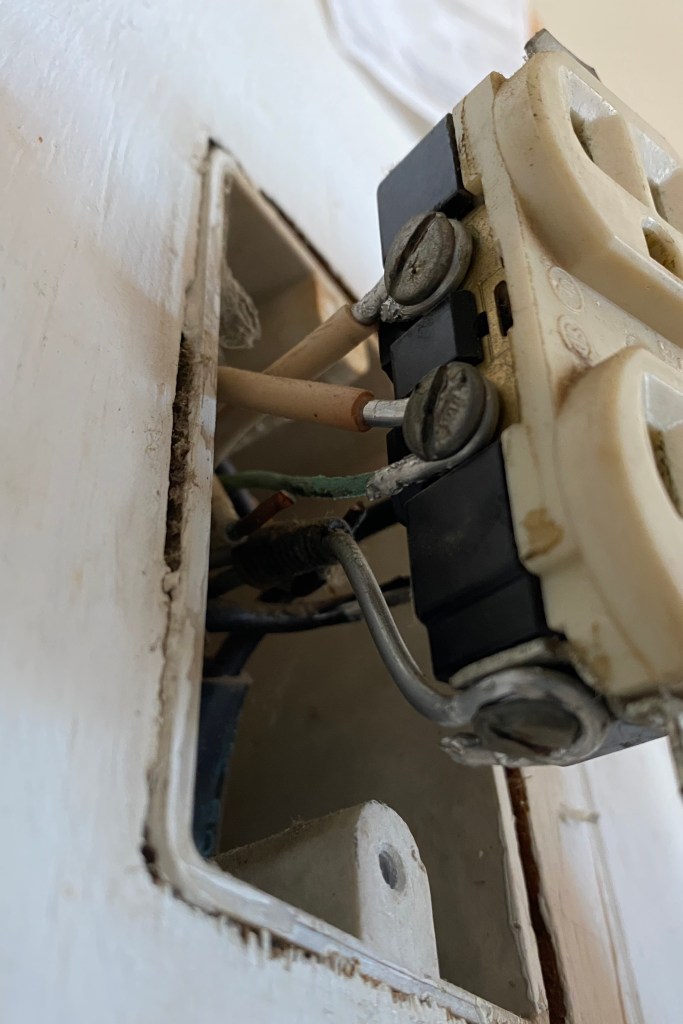
I had quickly pulled all of the receptacles to tackle later, but stumbled into this little gem just before I left for the week.

<sarcasm> Gosh, I have no idea why electrical at this end of the house is wonky. </sarcasm>

Count the number electrical issues this single modern receptacle:

  • That corroded (1) wire is meant to be the ground wire for the 14/2 cable.
  • It’s connected to the push-in neutral (2) side of the receptacle.
  • It’s aluminum, into a modern copper-receptacle (3).
  • There’s a neutral wire not connected (4).
  • There’s a hot (black) wire that’s connected to the grounding bus (5) for the receptacle.

At least the wires that I can see are routed the correct way round the terminals.

I think I have my Friday project selected.