On Driving

Never draw attention to your dash cam. And never make absurd feigned threats about “this is being recorded!”. Ignore it. Also, saying so only demonstrates that you’re an arsehole. And, as I’ve said before, your dash cam is as much a witness of you as it is of someone else.

Use the brakes. Seriously. There is no situation where adding more energy is going to be better or safer.

Never swerve. Also, see above on brakes. When you swerve, you actually take your focus off of where you’re going. You can absolutely swerve into another vehicle. Also, when you swerve, you take away traction from braking. I know what you’re saying, “but what about the car behind me?!? he’s not going to stop!” Uh-huh… it’s not your responsibility to control the vehicle behind you… that’s its driver’s responsibility. Because…

Remember, it’s a minimum of “two-second following distance”. It’s not “two car-lengths” nor “one car length for every ten miles an hour”. It’s not any length of cars — Smart car? Ford LTD? What length of car?

It’s two seconds.

Why? Because that’s how long it will take to recognize and react while maintaining control of your own vehicle.

On dry roads, not in a curve, it’s two seconds.

And if you’ve “better reflexes than everyone else” — you haven’t.

It’s still two seconds.

It takes about half a second (½) to recognize and react to something; then it takes another half to a full second for the application of the brakes. It’ll also require about another half to a full second for the vehicle mass to shift forward (yes, really) and for the suspension to compress to then apply maximum braking.

If you’re doing the math, that’s 1½ to 2½ seconds. Call it about two seconds. And that two seconds passes much faster than you think. The old adage about counting “One-thousand one, one-thousand two” Still pretty effective at judging following distance.

If you’re guesstimating the distance to the car ahead of you (which you’re guessing wrong) you will still need two full seconds to respond to the unexpected.

Wet roads? Add another second.

Poor visibility? Another second.

Snow? Add another two seconds.

The accelerator can never get you out of trouble. See above on the topic of brakes. More energy doesn’t equal more safer.

A roundabout is not a race track or a competition. Driver-Ed and the testing process badly needs to incorporate roundabouts into their methods and expose people to them. The first time many new drivers encounter them is in the real world only after they’ve earned a license.

The horn is to alert other drivers, it’s not to be used a signaling device or, worse, to blast every road user and pedestrian within 500ft for ten effing seconds after the real or perceived threat has passed.

Also, the throttle on a motorcycle is not a signaling device. Great, you can twist a throttle and bounce the motor off of its rev-limiter. Engine noise is ubiquitous and quite easily ignored — we hear it all the time. If only there was something that had a unique sound that could draw attention to a threat?

Oh! I know! We could use a horn! And make it readily accessible within hands reach to the vehicle operator!

Never pull over to the inside (left) shoulder. Work your way over to the outside (right) shoulder. Obviously, opposite in lefthand drive countries. Move to the outside lane.

If you’ve been hit or bumped, do not get out and immediately inspect the damage. Show some compassion. Check first on the driver and passengers of the other car to see if they’re injured.

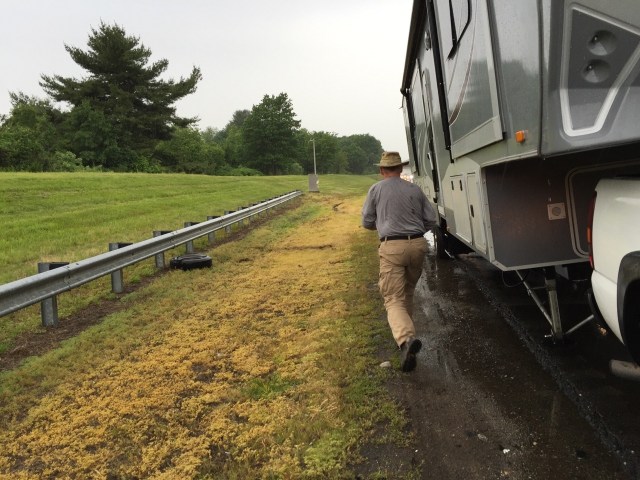
Never run to an accident. I can’t stress this enough. Look around for risks. Yes, move with intent and purpose. But never run. While you’re busy running across a three-lane interstate, other vehicles who didn’t see the incident are most certainly not expecting to see a person darting into traffic.

If there’s snow or ice visible on the road, slow down.

Never chase down somebody who ran from a collision. You have a dash cam — yes, I know they’re not ideal for capturing license plates at night — but only follow enough to improve the odds that the camera is going to capture sufficient video of the incident. Put another way, unless you are a police officer, do not chase down an offender. You’ve captured the video on camera. Stop and notify law enforcement and your insurance company and give them a completely unedited copy of the video.

Optimistic Numbers?

Starting to think that the state has some optimistically-low weight measurements for 2-ton-class diesel trucks.

Yes, yes, that’s a “Scale Weight”, which is pretty much an “empty” weight.

…without a driver, 40-gallons of fuel. No batteries, engine oil, brake fluid, hydraulic fluids, and quite possibly without a spare tire. Nor jack. Or I’m guessing lug-nuts nor road tires.

The vehicle, in road-use condition, with all of that stuff and, minimally, a 160lb driver, it weighs in at 7,200 lb on the scale. So I’m trying to figure out if that scale weight is optimistically low, or if the highway scale is measuring heavy, or if somehow I managed to violate the laws of physics.

Or somewhere in between.

Then again, I learned, quite surprisingly, that as of January 1, the entirety of Washington State no longer requires any vehicles to undergo emissions test prior to licensing.

EV vs. Internal Combustion Comparison, Pt. II

This was going to be a brief addendum to my somewhat cryptic “Do the math” remark that I made the other day. But then I realized that the remarks were more of a simplistic, “See also…” and a few trivial clarifiers on questions I’d received.

It’s become more of a diatribe.

Because a few people started countering with a slew of, “Yeah, but…” and “Have you thought about…”

A couple of things to keep in mind:

  • I didn’t assemble that particular form.
  • Don’t read into it or assume things.
  • And I hear you yelling, “But I need my leased car to get 1500 miles per day and I expect it to get 600 miles between refueling and only need 26.3 seconds to refuel!” — No, you don’t. Nor does your own bladder. Because physics. And physiology. You cannot sit in a single seat, unmoving, for more than two or three hours.
  • “But it’s not in kilometers!” or “I need to have Canadian dollars (or AUD or LKR), you Amero-centric A-hole!” Fine, then think of it as being unit-less. Just envision that it uses your own symbol — the math is exactly the same.
  • For the questions themselves, I’ll see if I can simplify them — you know, by not reading into them:
  1. Miles driven per month
    On average. In the average month, how far will you drive? My father has a 1998 Sebring with 175,000 miles on the odometer. That works out to about 700 miles per month.
    Example: 1250
  2. Average Wh/mi consumption
    This one’s a bit less clear, but it refers to a given EV. They’re often about 280 Wh/mile, but it also links to some general guidelines so you can pick/choose. The Jag and Audi will get insanely-inefficient ratings.
    Example: 385
  3. Electricity cost per kWh
    In Washington, it’s typical to see energy at an insanely low 5¢/kWh (we actually pay 4.98 cents per kWh, but who’s counting?). Other areas around NA might be as high as 20 or 25¢ per kWh. Use the dollar value. Not cents.
    Example: 0.0498
  4. Fuel Efficiency MPG
    Do the math and calculate how much fuel your car actually uses. Do not rely solely on its onboard computer. Do the math to see how your fuel consumption varies over time. To calculate your mileage, when you fill the tank, write down the Starting odometer reading. Fill the tank (don’t top it off or wait until the temperature is “perfect”, just fill it), then just drive it like you normally do. Next, write down your Ending mileage when you next fill the tank. Subtract Starting from Ending. That’s how far you’ve driven — the M part of MPG. Now divide that by the number of Gallons you just added to the tank. That’s the G part. Or:
    MPG = ( Ending – Starting ) / Gallons
    Example: 22
  5. Fuel cost per gallon
    Obviously, this will vary. But we’re only looking for the average fuel cost over time. Not day by day, nor hour by hour — and certainly not by trying to save four cents per gallon by driving 43 miles across a metro area. Just the general fuel price in your area.
    Example: 3.30

So, what are the results for our examples?

Why aren’t you using an EV?!

And it doesn’t touch on oil changes. But that’s another rant.