From Management*

*Not really from management, but masquerading as management — it’s a broadcast phishing attempt that made it through the mail filters at work:

All,

You’re satisfaction as an employee of our company is of vital importance to us. This is why we have created a quick, ten question survye to better assess whether we are meeting the needs of our employees; now is a great time to address questions or concerns and improve your employee experience moving forward.

Please take a few minutes to complete this survey. All participants will be considered for a gift card giveaway.

The survey can be found here: [Link Redacted]

Thank you,

Management

It’s a trap!

Well, you signed it as Management — and, though I intentionally redacted the link itself, the link did have the name “management” included.

But even more obvious to me are the numerous tells:

  • you’ve used the contraction for ‘you are’ rather than the possessive form.
  • you’ve misspelled ‘survey’.
  • perhaps subtle, it’s strange that you’ve used a contraction (while incorrect) but that you’ve not used contractions elsewhere.
  • you haven’t actually identified who “we” are or whom management is managing.
  • the message headers (redacted, because I don’t feel like sifting through the data) don’t include any reference to our domain other than the recipient.

These are a few of the things that were obvious to me, but would no doubt have (did?) tricked CowOrkers into clicking through.

What I’m a bit disappointed by is that our organization no longer has the Notify or Report option in Outlook. It was a feature that was integrated into MS Outlook to notify the internal security team of threats detected. I guess it was short-lived.

I wonder whether they don’t care, that they were getting inundated by the barrage of mistaken (or legitimate) messages, or if the option had been mistakenly removed from Outlook.

But, there you go — the more you know.

Time-observing…

One of the things that I still struggle with is the dependence, here, upon an exact and incredibly flawed method of accounting for dates. They insist that dates must be written in an mm/dd/yy fashion.

This is, for an old-school computer geek, somewhat challenging. Let’s say that we need to account for the third of February, 2004 (yes, past; follow along).

According to that standard, it would be written as

2/3/4

Why? Because if the mask was MM/DD/YY, then it would be

02/03/04

In the military, we had a slightly different written date style:

DDMonYY

Where that same day referenced above would be written as

03FEB04

God help you if you’re accustomed to a Day, Month, Year order. In any case, there would need to be a customary or even tribal knowledge of how dates are used and referred to.

When I wrote code and scripts for automation, I always ordered in Year-Month-Day because it was easier to quickly sort and scan through the lists.

Thank The Maker that the 2000’s — or, the naughties — are far into our pasts.

Words Mean Things, a correction

A few months ago, I did a brief rant about a mechanic/fabrication test question that used angle in reference to a distance.

Diameters.

At issue was the size of an angle in reference and relation to a diameter — a diameter that would be on the order of a few fractions of an inch to a few inches. A bend radius of a wire or wire bundle.

It has now occurred to me that, yes, you most absolutely can use an angle to measure a radius.

We use the concept of angular diameter in calculating long-range distances of several hundred meters. Rather, in that regard, we use the (forced) perspective and a few simple trigonometric functions (sine, cosine, tangent) to measure a distance to a target.

We often use angular diameter in astronomy to determine the distance to a star or to a galaxy.

I will stand, therefore, partially corrected.

I still think it’s abnormal to refer to the angle of a radius.

How Much Time?

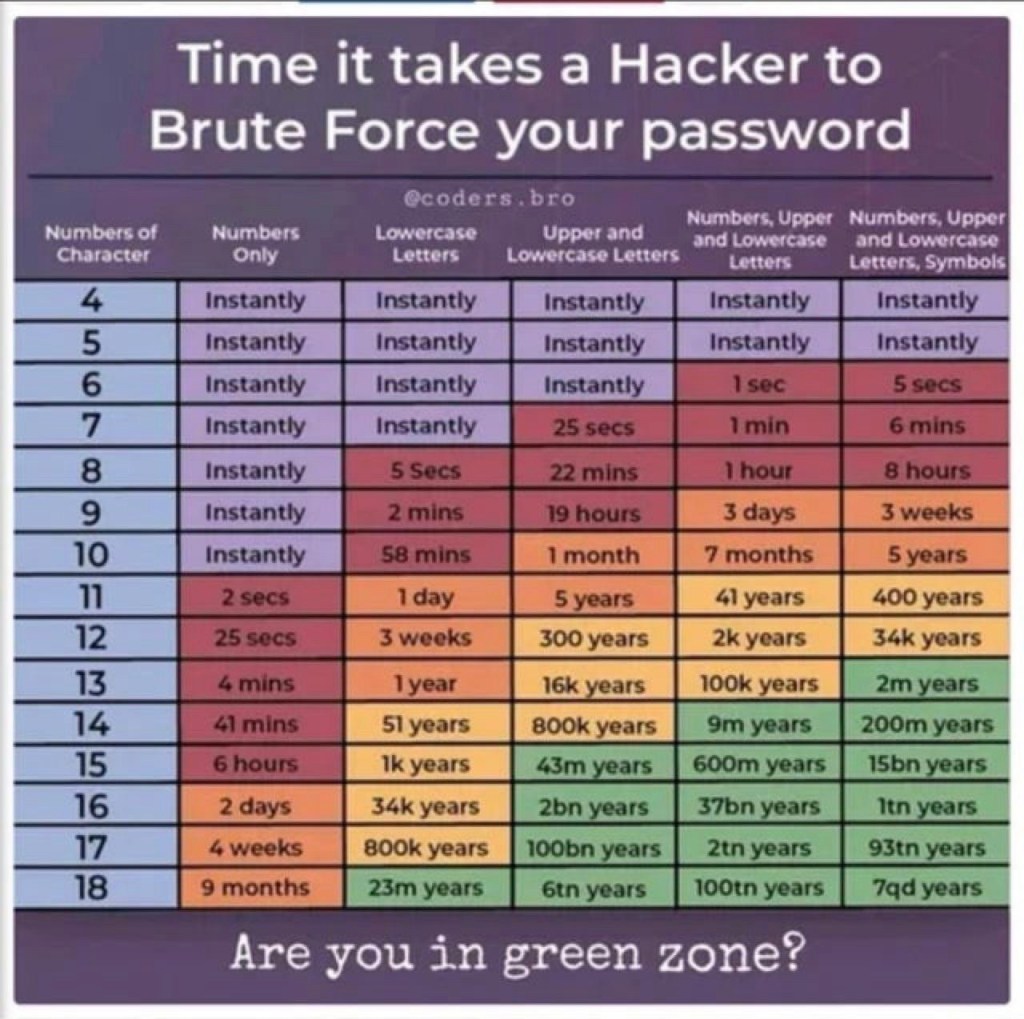
I had a conversation some years ago about the use of RSA keys for SSH/SFTP access. Something about how someone wanted a shorter key rather than a longer one. I think with the entirely contrived example we presented the averages were like 4wks for their short key vs about 32 trillion years for the one we recommended.

And that was with one computer trying 1000 times per second.