Anti-Impossibility?

If a distinguished but elderly scientist states that something is possible, he is almost certainly right. When he states that something is impossible, he is very probably wrong.

— Arthur C. Clarke

I’d like to have a more accurate reference but presently lack the inertia to track it down. Not that I necessarily doubt that he said or wrote that, but I’d like to attribute it more accurately to a speech, paper, or book.

Also, I will never assert that something is impossible.

This Is An Alert…

Please god—you do not need to send alerts for absolutely every automatic process. And, no, “just in case” is even more meaningless.

Alerts are an interruption for someone. It’s a mechanism to tell someone that something has occured that the automation doesn’t know how to handle. This has happened, here’s why and what you need to do.

I can’t count the number of times that I’ve seen alerts going out to interrupt everyone to let them know that automation has done the automatic things that it was normally expected to do.

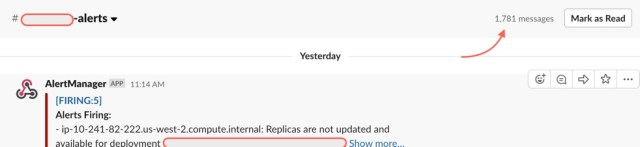
Image 5-1-19 at 10.12
In 24h, this channel was notifying the SRE team of — automation doing its job. 1,781 times.

It’s exactly like sending…

*thump*

…a notification for every…

*thump*

…heartbeat. I only want to know…

*thump*

…if it’s not doing what it’s…

*thump*

…implemented to handle…

*beeeeeeeep*

…automatically. Then I’ll worry about it.

End of the Smartphone?

Samsung hasn’t had the best of luck with certain tech. Not long ago, its top-load washing-machines turned into guillotines with regular usage — glass lids parting company with the slightest vibration.

And there was the Note 7 smartphone, which had a tendency to spontaneously and spectacularly burst into flame.

And now, with the release — and retraction within a few short days — of Samsung’s latest folding phone, I feel that it doesn’t bode well for Samsung, but it also indicates the looming end of an era: smartphones have Jumped the Shark.

But it folds!

And it fails.

Quickly.

Go ahead. Go Google samsung fold fail. I’ll wait. Here, I’ll do it for you:

Screen Shot 2019-05-02 at 07.37.54

It’s also amazingly expensive. If you think a top of the line smartphone is pricey at US$1,100, that folding Samsung monstrosity is twice the cost.

Oh, and it flounders — it’s not waterproof.

I’m starting to suspect that Samsung’s business model — once thought to be a cost-savings process not expending resources on engineering, QA, or Product-testing teams — instead relies on consumers to buy their quickly-conceived products so they can try them out and find faults and failures.

That means that you’re not only going to buy a shoddy product, but you’re also going to do the testing and provide marketing feedback for them!

It’s a win/win from Samsung’s perspective. But a fail/fail for the longer-term. That feedback part that will be detrimental to them in the long-term.

Assumptions

Don’t assume that somebody else possesses the same knowledge that you do. And never become frustrated when you feel that you’re either talking beyond them, or well-beneath them.

Another person’s knowledge and experience differs.

You will need to find a way to communicate your ideas at a level that they can understand.

This means you’ll need to reduce the concepts significantly…

…or expand your own knowledge to communicate at a differing level than you’re accustomed to.

Also, common sense isn’t.