Which RV?

When wading into the Full-Time RV waters, one quickly sees that there are hundreds of choices in teardrops, popups, hybrids, travel trailers, fifth wheels, and motorhomes. There’s just so much to choose from.

I’ve even seen people pulling medium-sized travel trailers behind large motorhomes!


Found on the web: A motorhome towing a custom-painted travel trailer.

Clearly, we need to set some ground rules that will help us to decide what trailer we want to call home. Some of our starting requirements:

  • New. Yup. I said it, “New.” Not used. Not “pre-owned”. Not “gently-loved”. New. That doesn’t mean that one can’t find great deals on last-year’s models still taking up space on dealer’s lots. In fact, those would be ideal for us.
  • Towables only; no motorhomes. “New” means that the entry cost of a current-model motorhome is incompatible with our budget predictions.
  • Hard-side models only. The comfort we prefer in the climate extremes in which we’re interested aren’t necessarily well-suited to the canvas walls or bed ends of popups or hybrids for full-time use.
  • Fixed beds for everyone. Lots of RVs claim to sleep 8 or 10 people, but with the exception of the owner’s queen- or king-sized bed, it often requires that you unfold a couch or transform the dinette into a bed. We want our kids to each have a bed that doesn’t require rearranging the living space to get to it.
  • Sufficient storage for bicycles, outdoor furnishings, tools, and support equipment for the RV.
  • Indoor sanitation*. A full bath is a plus, but ¾ bath is a minimum.
  • Full kitchen facilities*. Sink, refrigerator, cooktop, oven, microwave or convection oven combination.
  • Heat and A/C*. The extremes in our preferred environment can be from 15F to 95F, so a bit of modern machinery to maintain comfort is important.

Those last three items are usually standard equipment on every modern towable.

So, essentially we’re looking at new, bunkhouse-type travel trailers and fifth wheels.

There are still lots of choices in that regard. Here are a few representative models in varying sizes that tend to fit those criteria:

Small


Jayco 228: A wonderful little travel trailer that has all of the amenities. But, for full-time use for our family of four, we think it’s just too small.

Medium


Jayco Half-Ton 27.5BHS: A fifth-wheel with what we would consider our minimum livable space.

Large


Coachman Freedom Express 320BHDS: Those larger slides make a more spacious interior. It’s toward the larger end for our preference in travel-trailer-class towables.

Jumbo


Heartland Cyclone CY4100KING. How about a two bedroom (one is a loft), 1-½ bath, with a one-car garage, and a deck? Very nice, but possibly too big for us!

Again: these are just broadly representative of the choices out there. Presently, we can look for the Goldilocks trailer — it’s not too small, not too large, but just right for us. We have some time.

The Mountain Ahead of Us

When we start thinking through all of the things that need to happen for us to move from our suburban tract home into a new RV, there’s a bit of planning. Our primary tasks list starts out easy enough then start to grow:

  1. Come to terms with any necessary psychological and lifestyle changes. While this is only meant to be a year or two, we must enter this with the mindset that it’s a permanent change.
  2. Thin out our belongings. Sell things with value, give away to Goodwill those things that are still useful, and dispose of anything broken. Repeat as needed.
  3. Make work arrangements; can I telecommute full time? Or do I need to consider seeking employment relative to where we want to land?
  4. Prepare our house for sale or rent. We have so many things that we need to address before we can sell this house: I need to lay a new floor and trim out the basement; replace the fence; get some sort of consistent landscaping in the back yard; replace a basement floor drain. Those of you who live in small apartments and condos: we envy you greatly.
  5. Obtain or prepare your tow vehicle. Our little Pathfinder won’t tow the 7,500 to 11,000 lb trailers that we’re considering. We’ll need a larger tow vehicle.
  6. Order our new home. If we order from a factory, we’re told that it would take about six weeks for delivery. But what’s more likely is that we’ll need to check periodically with local dealers and be prepared to act on a model that we want when the time is right. That means we’ll need some sort of a financial plan ready to execute. Even then, we’re looking at a week or two for delivery.
  7. Make adjustments to the new RV to accommodate our family.

As we consider drilling down through each of those subtasks, we realize that there’s an absolute mountain of planning and work ahead of us.

And we’re completely confident that it will be entirely worthwhile.

Where We’re Going

We’ve really enjoyed our little Jayco trailer.

Sure, the geriatric Pathfinder struggles a bit with it, but it does nearly double its weight, so that’s understandable. Add its age to the altitude and multiply by the grade of an uphill climb and we sometimes struggle to stay above 35mph.

Our wee home away from home.

Anyway, even if we can only get away for a weekend to the State Park that’s only 3 miles away, we consider it a worthwhile trip.

We’ve so far been in temperatures as cold as about 24F and as hot as 90F. As long as there’s electricity, it’s pretty comfortable for us.

There are a few things we’d like to change on our little trailer. Memory foam mattress toppers, some bunk-end covers to take the edge off on both the hottest and coldest days and nights, a larger tow vehicle, maybe one of those awning-screen-room add-ons.

We’ll get to them as finances for our house and time permit.

Last September, we went up to St. Vrain State Park north of Denver for a weekend. I wasn’t feeling well and was a bit additionally stressed out by work.

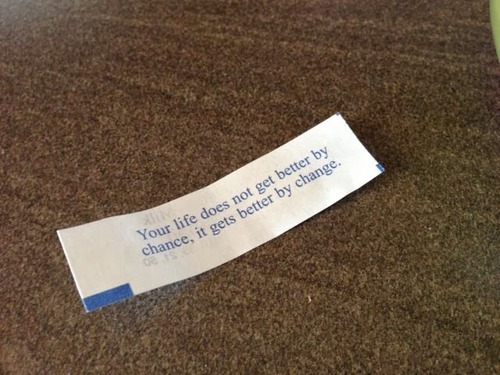
That Saturday evening, while pondering aloud after possibly imbibing in one too many bottles of carbonated, fermented goodness, I cracked open my Chinese takeout fortune cookie (hey, sometimes you just don’t want to cook)…

One wonders how many ideas were the result of slightly too much porter with a fortune-cookie catalyst.

“What if we were to do this full-time?”

“What do you mean?”

“I wonder if it would be cheaper to just have the RV than just the house. What if we were to sell the house and live in an RV full-time for six months… or a year… or two?”

She knew I wasn’t talking about this specific trailer. Sure, it’s entirely possible to live in it full time, but I don’t think our kids (or Daisy’s sanity) would tolerate it.

“We could move back to Washington,” she added, “Be closer to our families.”

“Or at least we’d certainly not be tied down by the house so we could get up there more often.”

The next weekend, which happened to be when the torrential rains were overtopping dams and flooding much of northern Colorado, we started looking at larger and larger travel trailers. I think she was spending more time looking than even I was.

It was then that we decided which course we wanted to take. We don’t know exactly what the roadmap looks like yet and we don’t know exactly when it will be, but we are absolutely convinced that right now, home ownership, here, isn’t for us.

It’s time to downsize dramatically for what we would consider a psychological reboot and a drastic change in our current lifestyle.

But how do we really start?

The Story So Far

“Well, let’s see. First the earth cooled. And then the dinosaurs came, but they got too big and fat, so they all died and they turned into oil.” — Airplane II

One of the things we always wanted to do was buy an RV. My folks have been RVers since I was in Jr. High and their love of the lifestyle seemed to rub off on me. A lot. They’d even share stories of the Airstream that my grandpa towed with the family sedan — a 1960-something Bonneville.

For all the years Daisy and I have been together, I’d dragged her to the local RV shows and we’d gazed at the assortment of tent trailers and travel trailers and motorhomes and accessories.

“Just wait until we buy a house,” we’d always say.

Our mentality was that once we do the responsible thing and buy a house, then we could justify the luxury.

So, we set about the path and bought a fixer-upper in suburbia whose fixer-upper costs started to climb. The RV was postponed again and again.

February, 2012, my dad called to tell us that mother was diagnosed with advanced lung cancer. It was hard news to hear, especially because of who was afflicted, but additionally so because I understood the prognosis.

We packed the kids into the car, or rented minivan, or I on my motorcycle, and made as many trips back up to Washington to see her as we could.

After the inevitable, a year after her diagnosis, while on the road home from the final farewell, I had an uncomfortably long time alone with my thoughts and wound up rationalizing just buying an RV.

Well, a travel trailer.

We had no savings, not much in the way of disposable income, and not a very large parking area for when it wouldn’t be used. But we did have reasonable credit and my mental justification that if I don’t just go do it, then it’ll never happen.

A week later, we found ourselves on a dealer’s lot examining travel trailers — and I considering carefully all of the advice that my parents shared about such things over the years.

I signed the paperwork on our wee little Jayco UltraLite that evening.

We didn’t get a chance to use it for about a month when the weather warmed a bit.

Oh, and the first thing I added to it: a picture frame for mother’s picture.

Where Are We?

Here we are… 2014 is just around the corner.

We’re in our early 40’s with two two pre-schoolers. There’s the dog and two cars in our small, fixer-upper house in a generic suburb, in a city near Denver, Colorado.

I work a fair number of hours as a Sr. Unix Engineer for a multi-national company. The compensation is reasonable, but the hours can be rough. Fortunately, I do get to telecommute regularly. Unfortunately, that means that I get an earlier start and a later stop on telecommute days.

Daisy holds the urban homestead together. The hours there, too, are long.
While our little family has our little house, we feel like we’ve become slaves to everything in and around it. The mortgage. The maintenance. The bills. The community.

It’s time for a change…